
PDF Ebook When Riot Cops Are Not Enough: The Policing and Repression of Occupy Oakland (Critical Issues in Crime and Society), by Mike King
Time is your own and just how you utilize your time is also yours. But here, we will help you to constantly utilize the time extremely well. Reading a book both from soft data and print documents could help you to earn far better understanding. You will certainly understand even more about something brand-new. When you don't check out When Riot Cops Are Not Enough: The Policing And Repression Of Occupy Oakland (Critical Issues In Crime And Society), By Mike King, you might not recognize and also realize around at least one thing. But recognize, by giving this suggested book, we are really sure that you can get it, also a minimum of one thing.
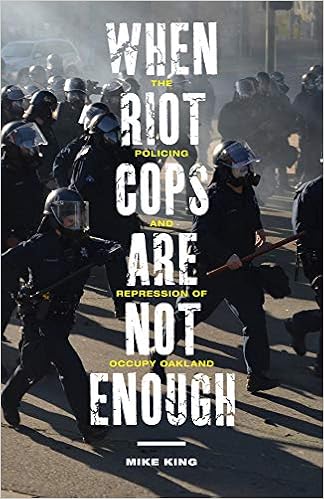
When Riot Cops Are Not Enough: The Policing and Repression of Occupy Oakland (Critical Issues in Crime and Society), by Mike King

PDF Ebook When Riot Cops Are Not Enough: The Policing and Repression of Occupy Oakland (Critical Issues in Crime and Society), by Mike King
Reserve When Riot Cops Are Not Enough: The Policing And Repression Of Occupy Oakland (Critical Issues In Crime And Society), By Mike King is one of the priceless worth that will certainly make you constantly rich. It will not mean as abundant as the cash give you. When some individuals have lack to deal with the life, individuals with many e-books in some cases will certainly be smarter in doing the life. Why need to be book When Riot Cops Are Not Enough: The Policing And Repression Of Occupy Oakland (Critical Issues In Crime And Society), By Mike King It is in fact not suggested that e-book When Riot Cops Are Not Enough: The Policing And Repression Of Occupy Oakland (Critical Issues In Crime And Society), By Mike King will give you power to get to every little thing. Guide is to read and exactly what we implied is the e-book that is reviewed. You could also see how the book entitles When Riot Cops Are Not Enough: The Policing And Repression Of Occupy Oakland (Critical Issues In Crime And Society), By Mike King and also varieties of book collections are giving here.
In spending the leisure time, many individuals have various means. But, to earn the very same one, checking out the When Riot Cops Are Not Enough: The Policing And Repression Of Occupy Oakland (Critical Issues In Crime And Society), By Mike King can be done perfectly. Even it is in different time, you all could acquire the functions and advantages of the book to read. It is type of book with the particular subject to get over the daily issues. When you require sort of enjoyment, this publication is likewise ideal sufficient.
By seeing this page, you have actually done the best gazing factor. This is your begin to select the book When Riot Cops Are Not Enough: The Policing And Repression Of Occupy Oakland (Critical Issues In Crime And Society), By Mike King that you desire. There are lots of referred e-books to read. When you would like to get this When Riot Cops Are Not Enough: The Policing And Repression Of Occupy Oakland (Critical Issues In Crime And Society), By Mike King as your book reading, you could click the web link page to download and install When Riot Cops Are Not Enough: The Policing And Repression Of Occupy Oakland (Critical Issues In Crime And Society), By Mike King In few time, you have actually possessed your referred publications as yours.
Beginning to read this publication can begin your possibility in doing this life much better. It will make you count on have more times or more spare times in reading. Alloting couple of times in a day just for analysis can be done as one of the efforts for you to complete your tasks. When you will certainly end the night before sleeping, When Riot Cops Are Not Enough: The Policing And Repression Of Occupy Oakland (Critical Issues In Crime And Society), By Mike King is additionally a good thing to accompany you.
Review
"By charting the tight interplay of resistance and repression that connects the murder of Oscar Grant to the Occupy Movement in Oakland and beyond, Mike King's book provides an essential weapon for our collective arsenal." (George Ciccariello-Maher author of We Created Chávez)"Mike King has produced a fascinating study of the repression of Occupy Oakland. His groundbreaking analysis ?makes sense of one of the most significant political episodes in recent American history. This is a compelling demonstration of what theoretically informed activist research can achieve." (Andrej Grubacic author of Living at the Edges of Capitalism)"Clear, concise, and compelling, When Riot Cops Are Not Enough is not only a deep and rich narrative, but an extremely valuable piece of ethnographic research." (Patrick Gillham department of sociology, Western Washington University)"As a piece of public sociology, the book furthers understanding of the policies and the politics of repression and social control." (American Journal of Sociology)
Read more
Review
“Vital, important and compelling, Mike King offers a nuanced accounting of the cat-and-mouse game of social protest and social control. Grounded in the experience of Occupy Oakland, When Riot Cops Are Not Enough is immensely relevant to the upcoming generation of militant activists, engaged scholars and community police.” (Endorsement)
Read more
See all Editorial Reviews
Product details
Series: Critical Issues in Crime and Society
Paperback: 192 pages
Publisher: Rutgers University Press; None edition (March 9, 2017)
Language: English
ISBN-10: 081358373X
ISBN-13: 978-0813583730
Product Dimensions:
5.5 x 0.6 x 8.5 inches
Shipping Weight: 11.2 ounces (View shipping rates and policies)
Average Customer Review:
4.0 out of 5 stars
1 customer review
Amazon Best Sellers Rank:
#2,056,415 in Books (See Top 100 in Books)
Having written a self-published, non-academic book about Occupy Oakland, I've been looking forward to a scholarly study. This pricey treatise by an assistant professor of criminal justice, published by Rutgers University Press, ostensibly fills that void. However, author Mike King, Ph.D., wears two hats: sociologist and activist. "My role as a participant observer and ethnographer," King relates, "grew out of my already existing extensive involvement in Occupy Oakland." He organized, facilitated meetings, made flyers, and served as press liaison. Whenever possible, he uses the pronoun "we" to incorporate himself (and even his children) into the protest group. He acknowledges, "Love and respect is due to everyone involved in Occupy Oakland who made it what it was." Obviously, this is no objective examination by a detached social scientist.King's loving and respectful insider take may nevertheless rankle true believers. As he recounts, militancy "was a founding characteristic" of Occupy Oakland, which "was largely populated by seasoned militant activists who had prior experience in conflict with the OPD [Oakland Police Department]." From the outset, these hardliners renounced negotiation with authorities. "The camp and the broader community that was Occupy Oakland … was far more hostile to existing political structures than disillusioned by them. From the very first day, the stage was set for an inevitable conflict between the movement and the administration of the city."This contradicts the romanticized narrative of innocent protestors being unexpectedly attacked by police. Occupy Oakland orchestrated that showdown, and the City of Oakland—possessed of every tactical advantage but strategically clueless—played right into their hands.Yet within 95 days, the political opportunity initially seized by Occupy Oakland had been squandered. "The two main mechanisms of protest movement social control," King observes, "physical force and negotiation … failed dramatically in Oakland in the fall of 2011," but "were reconstituted relatively quickly," as "the movement was successfully marginalized, demonized, criminalized." The public's perception of police repression shifted "from illegitimate to warranted." Occupy Oakland's downfall, King argues, "ultimately had more to do with effectively painting the movement as violent, apolitical, socially marginal, dangerous, irresponsible, and internally fractured than it did with street policing tactics."Disappointingly, rather than interrogate the antics that made this portrait resonate, King blames politicians and press for focusing on them. Writing about OO's January 27, 2012 Move-In Day, in which occupiers tried to take over the city-owned, unused Kaiser Convention Center, King concludes, "The planning and coordination of the movement's action left much to be desired." WTF? Move-In Day was widely regarded, including by many would-be occupiers, as a self-inflicted clusterf**k that would in time prove fatal. Yet instead of holding Move-In Day's recklessly inept planners accountable, Mike King attacks the messenger, scolding in particular the San Francisco Chronicle for "overtly seeking to marginalize Occupy Oakland" and "discursively undermine militant, risky, or otherwise unsanctioned actions."Likewise, King totally ignores Black Bloc, OO's roving riot tourists, dressed in all black and carrying black flags, with black hoodies pulled over their heads and black bandanas concealing their pasty white faces. In mid-October 2011, OO handed Black Bloc a blank check, resolving: "Occupy Oakland encourages diversity of tactics [code for violence] for actions that occur outside the camp."Accordingly, during OO's otherwise hugely successful Nov. 2, 2011, General Strike & Anti-Capitalist March, which shut down the Port of Oakland, Black Bloc gleefully smashed plate-glass windows, spray-painted STRIKE in 12-foot-high letters on the façade of a Whole Foods Market in Adams Point, barricaded 16th Street at both ends with wooden pallets, trash cans, tables and tires, started a massive trash fire at 16th & Broadway that sent flames 15 feet high, and pelted first responders with a fusillade of bottles, rocks and chunks of broken concrete. This media-magnetic hooliganism stole the show, vaporizing Occupy Oakland's goodwill in the Bay Area and transforming overnight OO's greatest triumph into the beginning of its end. "The Black Bloc anarchists, who have been active on the streets in Oakland and other cities, are the cancer of the Occupy movement," wrote journalist and Occupy supporter Chris Hedges, who was of course roundly vilified by the collective.In February 2012, OO's Black Bloc contingent traveled to Sacramento, where they triggered a melee with police near the state Capitol. Back in Oakland, in what was billed as a May Day General Strike, Black Bloc again skirmished with police and committed de rigueur acts of vandalism. In July 2012, two blocks beyond the Secret Service protective perimeter at a campaign fundraiser hosting President Obama, Black Bloc burned not one but two American flags. Eleven days later, Black Bloc Ninjas smashed the plate-glass window of Obama's reelection campaign office, with people inside. In October 2012, OO's Black Block joined Afghans for Peace in marking the 11th anniversary of the U.S.-led War in Afghanistan, by conducting a 30-minute round of smashy in downtown streets.Sometimes King's insider vantage equips him not with insight but with blinders. His refusal to acknowledge Black Bloc's destructive effect on Occupy Oakland reduces my rating from 5 to 4 stars.
When Riot Cops Are Not Enough: The Policing and Repression of Occupy Oakland (Critical Issues in Crime and Society), by Mike King PDF
When Riot Cops Are Not Enough: The Policing and Repression of Occupy Oakland (Critical Issues in Crime and Society), by Mike King EPub
When Riot Cops Are Not Enough: The Policing and Repression of Occupy Oakland (Critical Issues in Crime and Society), by Mike King Doc
When Riot Cops Are Not Enough: The Policing and Repression of Occupy Oakland (Critical Issues in Crime and Society), by Mike King iBooks
When Riot Cops Are Not Enough: The Policing and Repression of Occupy Oakland (Critical Issues in Crime and Society), by Mike King rtf
When Riot Cops Are Not Enough: The Policing and Repression of Occupy Oakland (Critical Issues in Crime and Society), by Mike King Mobipocket
When Riot Cops Are Not Enough: The Policing and Repression of Occupy Oakland (Critical Issues in Crime and Society), by Mike King Kindle


0 komentar:
Posting Komentar